Each element in every atom is assigned a set of four quantum numbers and no two electrons can have the same quantum numbers.
1. The first number is the principle quantum number which is the principle energy level.
2. The second number is the angular momentum quantum number which is the sublevel but the sublevels are assigned number. 0 is s, 1 is p, 2 is d, and 3 is f.
3. The third number is the magnetic quantum number which is determined by how much of the orbitals are filled
4. The fourth number is the quantum spin number which is either +1/2 if its the first electron in an orbital or -1/2 if its the second.
This link has practice problems with the answers so you can check if you get it right.
Monday, February 29, 2016
Thursday, February 25, 2016
Spec 20
We used a spectrophotometer in lab today. We found percent transmittance and absorbency of cobalt and chromium by placing a cuvette into the machine and setting a certain wavelength. Here's my data from the lab.
And some pictures
| Cr Ion | ||
| Wavelength (nm) | % T | Absorbance |
| 375 | 59.2 | 0.226 |
| 400 | 49.4 | 0.306 |
| 405 | 49.2 | 0.309 |
| 415 | 50.2 | 0.300 |
| 425 | 54.4 | 0.264 |
| 440 | 62.6 | 0.203 |
| 455 | 72.8 | 0.138 |
| 470 | 80.2 | 0.096 |
| 490 | 81.2 | 0.091 |
| 500 | 80.4 | 0.094 |
| 520 | 72.6 | 0.139 |
| 530 | 68.2 | 0.167 |
| 540 | 63.8 | 0.196 |
| 550 | 60.4 | 0.219 |
| 570 | 56.8 | 0.245 |
| 580 | 57.0 | 0.245 |
| 600 | 62.4 | 0.205 |
| 625 | 72.6 | 0.138 |
| Co Ion | ||
| Wavelength (nm) | % T | Absorbance |
| 375 | 98.8 | 0.006 |
| 400 | 92.4 | 0.035 |
| 405 | 90.0 | 0.047 |
| 415 | 86.4 | 0.063 |
| 425 | 80.4 | 0.094 |
| 440 | 66.0 | 0.180 |
| 455 | 49.6 | 0.305 |
| 470 | 40.2 | 0.396 |
| 490 | 32.2 | 0.492 |
| 500 | 30.4 | 0.518 |
| 520 | 31.6 | 0.500 |
| 530 | 38.0 | 0.422 |
| 540 | 47.8 | 0.320 |
| 550 | 58.6 | 0.232 |
| 570 | 78.6 | 0.104 |
| 580 | 85.4 | 0.069 |
| 600 | 90.2 | 0.045 |
| 625 | 92.2 | 0.036 |
Sunday, February 21, 2016
Electron Configuration
The electron configuration of an atom is where the electrons are found and how many there are in an atom. There are four levels to describe the location of an electron in an atom: principle energy level, sublevel, orbitals, and spin. The principle energy level describes how far away from the nucleus an electron can be found. Its symbol is n. There are four different sublevels, s, p, d, and f. The first principle energy level only has one sublevel, the 1s sublevel. The second principle energy level has two sublevels, 2s and 2p. The third principle energy level has three sublevels, 3s, 3p, and 3d. The fourth and all subsequent principal energy levels have four sublevels, 4s, 4p, 4d, and 4f. Each sublevel ahs a specific number of orbitals, the s sublevel has one orbital that can hold 2 electrons, shaped like a sphere, the p sublevel has 3 orbitals that can hold 6 electrons, shaped like dumb-bells orientated perpendicular to each other around the x, y, and z axis, the d sublevel has 5 orbitals that can hold 10 electrons, and the f sublevel has 7 orbitals and can hold 14 electrons, both the d and f sublevels have complex shapes. Each electron is paired with another and they have opposite spins. 
When writing the electron configuration of an element the first number is the principle energy level then the sublevel then the number of electrons is the superscript. This link gives you practice writing the electron configuration for different elements.
Thursday, February 18, 2016
Flame Test
This lab was really neat. We did this lab to help us understand how wavelength corresponds to color. In the lab we burned a few chemicals and recorded the color we saw then using the color we looked up the wavelength.
Energy, Wavelength,and Frequency Calculations
All waves have wavelength, amplitude and frequency. If a wave has a short wavelength and a high amplitude it has high energy, but if a wave has a long wavelength and a low amplitude it has low energy. To find the speed of a wave you multiply wavelength and frequency together. Electromagnetic radiation moves through a vacuum at a speed of 3.00*10^8 m/s, so that is what we use for speed of a wave. You can also find how much energy is in a photon with a certain frequency. To do this you multiply the frequency by Planck's constant which is 6.63*10^-34 J*s.
This link gives you practice problems on how to find energy, wavelength and frequency, and it shows you how to do it if you get stuck.
Tuesday, February 9, 2016
Titrations Lab
We ran a lab this week similar to the one before, but this time to find the molar mass of an unknown acid. For this lab, we titrate an acid we are given to as I said before, find the molarity of it. First to start the lab, we had to standardize the base solution, so I weighed about 0.2g, added it to a Erlenmeyer flask by rinsing it with diluted water, added about 100mL of diluted water, added 2 drops of indicator, and finally titrated it until it turned pink. We did this twice and averaged the two for our calculations. When the solution turns pink, we know that all of the KHP had been reacted. Next, we did the same thing by titrating the unknown acid that we had to weigh. Finding the molarity in the first two and solving for just the moles of HA is what was then used for more calculations.
Here are some pictures from the lab:
Blame isn't really being assigned to anyone, but my lab partner and I (mostly her) broke and erlenmeyer flask. #chemfails :/
Here are some pictures from the lab:
Blame isn't really being assigned to anyone, but my lab partner and I (mostly her) broke and erlenmeyer flask. #chemfails :/
Friday, February 5, 2016
Percent Acid in Vinegar Lab
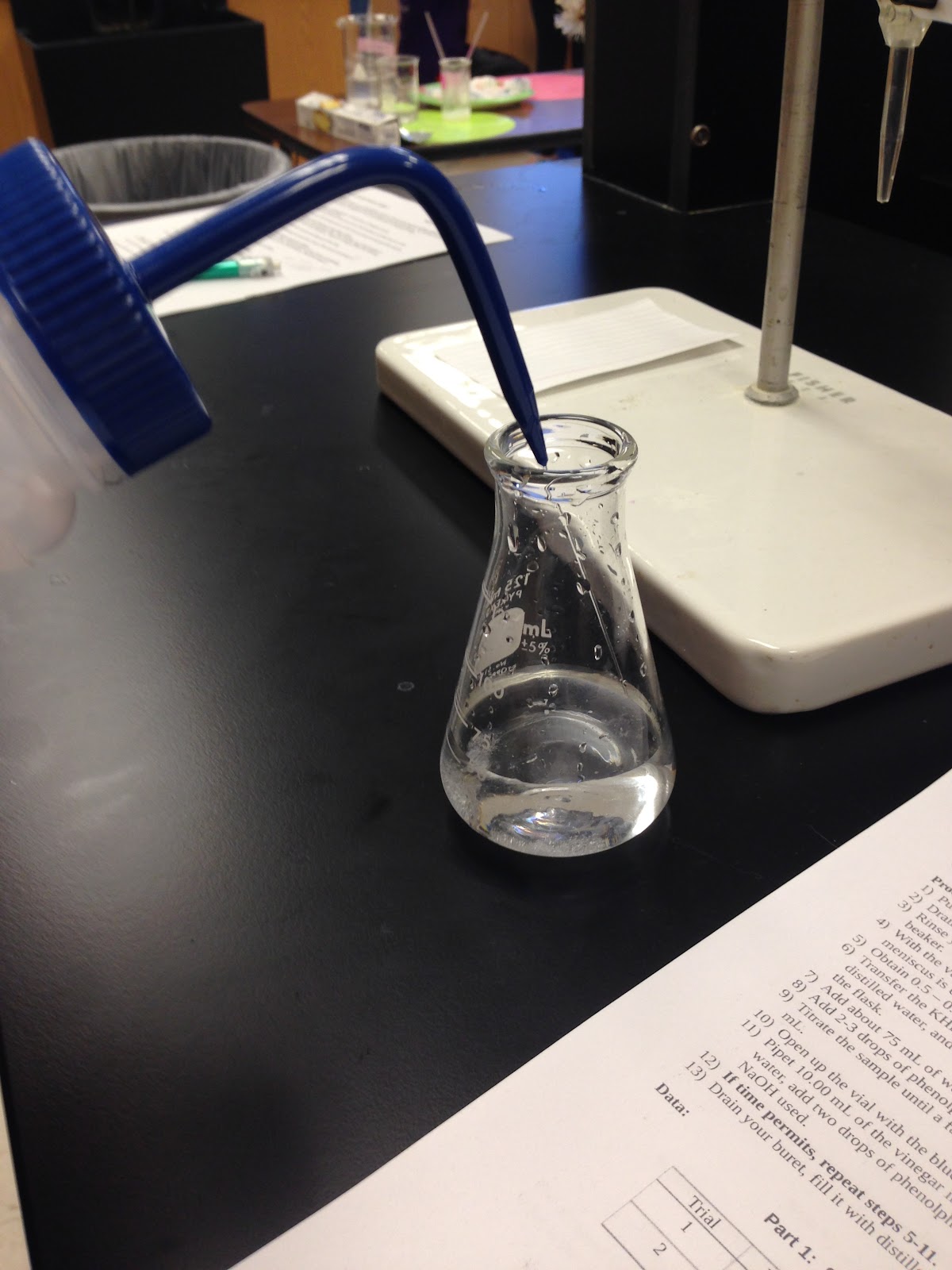
Over the last few days my lab partner and I have performed the Percent Acetic Acid in Vinegar lab. By standardizing a solution of NaOH with the acid potassium hydrogen phthalate, or KHP, in a titration we were able to determine the molarity of the NaOH solution. Using this standard NaOH solution, we were also able to determine the percent of acetic acid, HC2H3O2 in commercial vinegar.

Adding distilled water to the Erlenmeyer flask in order to dilute the vinegar

After adding two drops of the indicator phenolphthalein we were able to titrate the solution
After all of the titrations were complete, the calculations for the percent acetic acid in vinegar could be made by calculating the average molarity of NaOH and plugging that in to find the molarity of the acetic acid. The molarity could then be multiplied by the molar mass in order to find the mass of solute in the solution. With this mass the percent acetic acid in vinegar can be determined by dividing it by the volume of the solution.
This was helpful in calculating the percent acetic acid in vinegar
Adding distilled water to the Erlenmeyer flask in order to dilute the vinegar
After adding two drops of the indicator phenolphthalein we were able to titrate the solution
After all of the titrations were complete, the calculations for the percent acetic acid in vinegar could be made by calculating the average molarity of NaOH and plugging that in to find the molarity of the acetic acid. The molarity could then be multiplied by the molar mass in order to find the mass of solute in the solution. With this mass the percent acetic acid in vinegar can be determined by dividing it by the volume of the solution.
This was helpful in calculating the percent acetic acid in vinegar
Subscribe to:
Posts (Atom)